GBTDS
Roman’s Galactic Bulge Time-Domain Survey
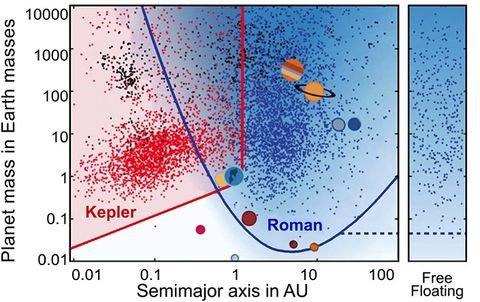
Roman will stare toward the crowded heart of the Milky Way, photographing roughly 100 million stars every few minutes to catch the brief brightening when a foreground star — or a lone planet — passes in front of a background star.
This effect, gravitational microlensing, can reveal planets in cold, distant orbits and even free-floating planets with no star at all — worlds that other methods struggle to see. The same data will also record many transiting planets and huge numbers of variable stars.
The adopted plan images five fields in the Galactic bulge and one field on the Galactic Center roughly every 12 minutes, across six observing seasons — three early and three late in the mission — covering about two square degrees.
- Fields
- 5 bulge fields + 1 Galactic Center field
- Cadence
- ≈ 12 minutes
- Seasons
- 6 (3 early, 3 late in the mission)
- Science
- Microlensing planets, free-floating planets, stellar variability


![Galactic Bulge Time-Domain Survey [figure A]](https://assets.science.nasa.gov/dynamicimage/assets/science/missions/rst/science/gbtds_figureA.png?w=480&fit=clip)